Introduction
The character of warfare is undergoing a fundamental transformation. Over the past decade, unmanned aerial systems (UAS) have evolved from niche surveillance tools into decisive assets capable of intelligence gathering, precision strikes, and large-scale coordinated attacks. The proliferation of low-cost drones—ranging from commercial quadcopters to sophisticated loitering munitions—has introduced new vulnerabilities in traditional air defence systems.
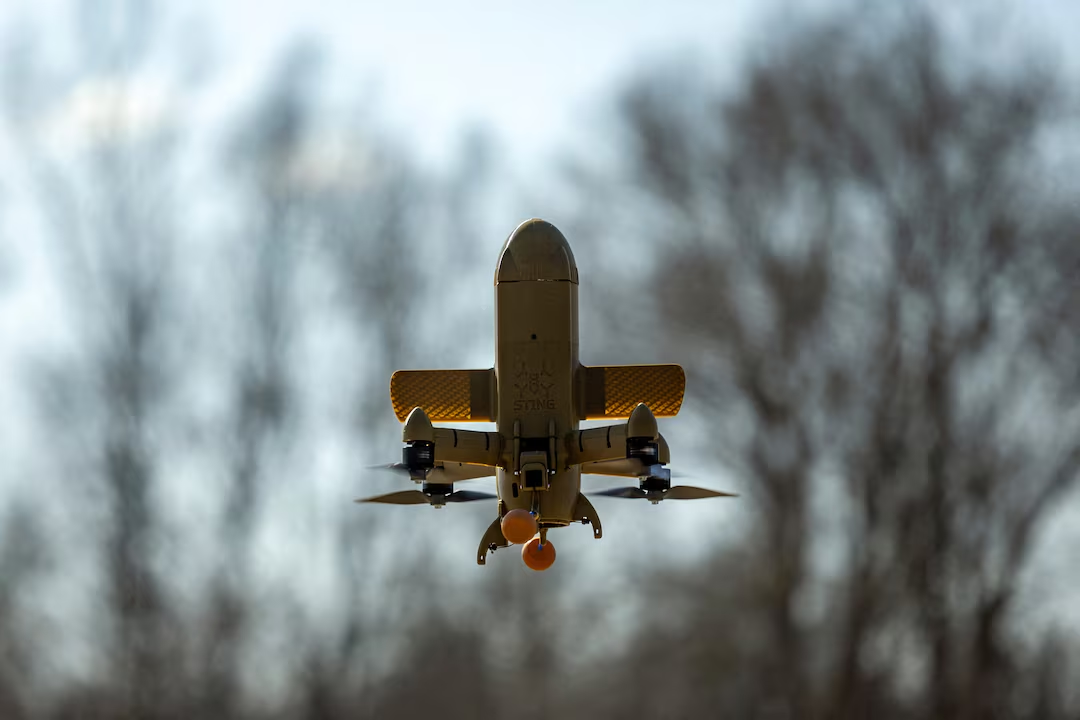
This shift has created an urgent requirement for agile, scalable, and cost-effective countermeasures. Among the most promising solutions is the emergence of interceptor drones—a new class of unmanned systems specifically designed to detect, pursue, and neutralise hostile aerial threats.
Interceptor drones are not merely an incremental improvement in defence technology; they represent a structural shift toward distributed, intelligent, and software-defined air defence architectures.
What Are Interceptor Drones?
Interceptor drones are unmanned aerial platforms engineered for counter-UAS (C-UAS) missions. Their primary objective is to intercept and neutralise hostile drones before they can reach their targets.
Unlike traditional air defence systems that rely heavily on radar-guided missiles or anti-aircraft artillery, interceptor drones are designed to operate in low-altitude, complex, and cluttered environments, where conventional systems often struggle.
Core Functional Capabilities
Target Detection Integration: Works with radar, RF sensors, electro-optical systems, and acoustic arrays
Autonomous Tracking: Uses onboard AI for real-time object detection and trajectory prediction
High-Speed Interception: Capable of rapid manoeuvring and pursuit
Neutralisation Mechanisms:
Kinetic impact (direct collision)
Fragmentation or explosive payloads
Net-based capture systems
Electronic warfare payloads (jamming/spoofing)
These systems are typically integrated into a broader, multi-layered air defence network that combines detection, command-and-control (C2), and response mechanisms.
The Technological Architecture of Interceptor Drones
Interceptor drone systems operate through a tightly integrated pipeline of sensing, computation, and action. This architecture can be broken down into four major layers:
- Detection and Identification
The first step in any interception process is identifying a potential threat. This is achieved through a combination of:
Radar systems for long-range detection
Radio frequency (RF) sensors to identify drone communication links
Electro-optical and infrared (EO/IR) cameras for visual confirmation
Acoustic sensors for detecting low-flying UAVs in urban terrain
Modern systems increasingly rely on sensor fusion, where multiple data streams are combined and processed using machine learning models to classify objects with high accuracy.
- Tracking and Prediction
Once a target is identified, the system must continuously track it and predict its trajectory. This involves:
Real-time kinematic modeling
Kalman filtering and predictive algorithms
AI-based behavioural analysis (e.g., distinguishing loitering munitions from surveillance drones)
Accurate tracking is essential for successful interception, particularly against fast-moving or evasive targets.
- Interception and Guidance
Interceptor drones are deployed either autonomously or via operator command. Key technological elements include:
Autonomous navigation systems using GPS, inertial measurement units (IMUs), and visual odometry
Computer vision algorithms for terminal guidance
Adaptive flight control systems for high-speed manoeuvrability
Advanced systems can operate in GPS-denied environments, relying on onboard perception and relative positioning.
- Neutralisation
The final stage involves disabling or destroying the target. The choice of neutralisation method depends on operational requirements:
Kinetic interception is cost-effective and widely used
Explosive payloads increase kill probability against larger drones
Non-kinetic methods (jamming, spoofing) are useful in controlled environments
Why Interceptor Drones Are a Strategic Breakthrough
Cost Asymmetry and Economic Efficiency
One of the most significant advantages of interceptor drones is their cost-effectiveness. Traditional air defence missiles can cost hundreds of thousands to millions of dollars per unit, while the drones they target may cost only a few hundred dollars.
Interceptor drones invert this cost equation by providing a low-cost interception solution, enabling sustained defence without exhausting high-value resources.
Scalability Against Drone Swarms
Modern threats increasingly involve drone swarms, where dozens or hundreds of UAVs are deployed simultaneously. Conventional systems struggle with such saturation attacks due to limited firing rates and high costs.
Interceptor drones can be deployed in large numbers, enabling swarm-on-swarm engagements and distributed defence strategies.
Mobility and Tactical Flexibility
Unlike fixed air defence installations, interceptor drone systems are highly mobile. They can be:
Mounted on vehicles
Deployed with infantry units
Integrated into forward operating bases
This mobility allows for the creation of dynamic protective zones that move with military assets.
Integration with AI and Autonomous Systems
Interceptor drones are inherently compatible with modern AI technologies, including:
Deep learning-based object detection
Autonomous decision-making systems
Multi-agent coordination algorithms
This enables faster response times and reduces reliance on human operators in high-intensity scenarios.
Operational Lessons from Recent Conflicts
Recent conflicts have demonstrated the growing importance of interceptor drones in real-world scenarios. In particular, the widespread use of low-cost attack drones and loitering munitions has exposed the limitations of traditional air defence systems.
Key observations include:
A significant percentage of aerial threats are now small, low-cost drones
High-cost missile systems are economically unsustainable against such threats
Interceptor drones have proven effective in neutralising short-range UAVs
Rapid production and deployment are critical for maintaining defence readiness
These developments highlight the transition toward attritable and expendable defence systems, where quantity and adaptability are as important as individual platform capability.
The Future of Interceptor Drone Warfare
Swarm-on-Swarm Combat
Future battlefields will likely feature autonomous drone swarms engaging each other, coordinated through decentralised communication networks and AI-driven decision-making.
Integrated Multi-Layered Defense Systems
Interceptor drones will become part of a broader ecosystem that includes:
Long-range radar systems
Electronic warfare platforms
Directed energy weapons (lasers, microwave systems)
Satellite-based surveillance
This layered approach will provide comprehensive coverage across different altitudes and threat types.
Human-Out-of-the-Loop Systems
Advances in AI will enable fully autonomous interception, where systems can detect, classify, and neutralise threats without human intervention. This raises both operational advantages and ethical considerations.
Energy-Based and Hybrid Interception
Future systems may combine interceptor drones with directed energy weapons, creating hybrid solutions that offer both precision and scalability.
Challenges and Limitations
Despite their advantages, interceptor drones face several technical and operational challenges:
Limited endurance and range compared to missile systems
Dependence on reliable detection infrastructure
Susceptibility to electronic warfare, including jamming and spoofing
Complexity in managing large-scale swarm engagements
These limitations reinforce the need for integrated defence architectures rather than standalone solutions.
Implications for India and Indigenous Innovation
India is at a critical juncture in adopting and developing counter-drone technologies. With increasing incidents involving cross-border drone activity and the global shift toward autonomous warfare, there is a strong need for indigenous, scalable, and cost-effective solutions.
Key opportunities include:
Development of AI-powered interceptor drones
Indigenous counter-UAS platforms for defence forces
Integration of swarm intelligence and autonomous coordination
Dual-use technologies for both military and homeland security applications
Startups like SkySentinel are uniquely positioned to contribute to this ecosystem by combining expertise in UAV systems, AI, and mission software to build next-generation defence solutions.